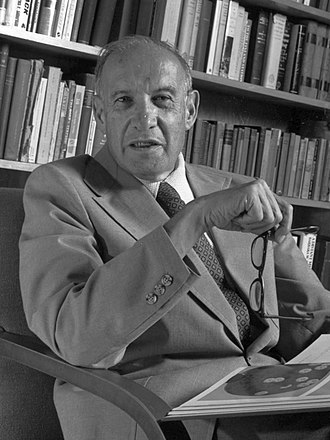
Peter Drucker
columnist, economist, writer, university teacher, journalist, lawyer, sculptor, businessperson, philosopher
Read on Wikipedia1909 – 2005
All Quotes by Peter Drucker
“There is nothing so useless as doing efficiently that which should not be done at all.”
“The most important thing in communication is hearing what isn't said.”
“Management is doing things right; leadership is doing the right things.”
“Knowledge has to be improved, challenged, and increased constantly, or it vanishes.”
“Time is the scarcest resource and unless it is managed nothing else can be managed.”
“Rank does not confer privilege or give power. It imposes responsibility.”
“The only thing we know about the future is that it will be different.”
“Never mind your happiness; do your duty.”
“Follow effective action with quiet reflection. From the quiet reflection will come even more effective action.”
“Effective leadership is not about making speeches or being liked; leadership is defined by results not attributes.”
“Trying to predict the future is like trying to drive down a country road at night with no lights while looking out the back window.”
“No institution can possibly survive if it needs geniuses or supermen to manage it. It must be organized in such a way as to be able to get along under a leadership composed of average human beings.”
“The computer is a moron.”
“Management by objective works - if you know the objectives. Ninety percent of the time you don't.”
“People who don't take risks generally make about two big mistakes a year. People who do take risks generally make about two big mistakes a year.”
“Checking the results of a decision against its expectations shows executives what their strengths are, where they need to improve, and where they lack knowledge or information.”
“Teaching is the only major occupation of man for which we have not yet developed tools that make an average person capable of competence and performance. In teaching we rely on the 'naturals', the ones who somehow know how to teach.”
“Few companies that installed computers to reduce the employment of clerks have realized their expectations... They now need more, and more expensive clerks even though they call them 'operators' or 'programmers.'”
“Executives owe it to the organization and to their fellow workers not to tolerate nonperforming individuals in important jobs.”
“A manager is responsible for the application and performance of knowledge.”
“The new information technology... Internet and e-mail... have practically eliminated the physical costs of communications.”
“We can say with certainty - or 90% probability - that the new industries that are about to be born will have nothing to do with information.”
“Suppliers and especially manufacturers have market power because they have information about a product or a service that the customer does not and cannot have, and does not need if he can trust the brand. This explains the profitability of brands.”
“We now accept the fact that learning is a lifelong process of keeping abreast of change. And the most pressing task is to teach people how to learn.”
“Never mind your happiness; do your duty.”
“The best way to predict the future is to create it.”
“Efficiency is doing things right; effectiveness is doing the right things.”
“Plans are only good intentions unless they immediately degenerate into hard work.”
“Unless commitment is made, there are only promises and hopes... but no plans.”
“Making good decisions is a crucial skill at every level.”
“We now accept the fact that learning is a lifelong process of keeping abreast of change. And the most pressing task is to teach people how to learn.”
“The aim of marketing is to know and understand the customer so well the product or service fits him and sells itself.”
“The entrepreneur always searches for change, responds to it, and exploits it as an opportunity.”
“The purpose of a business is to create a customer.”
“Business, that's easily defined - it's other people's money.”
“Innovation is the specific instrument of entrepreneurship. The act that endows resources with a new capacity to create wealth.”
“The productivity of work is not the responsibility of the worker but of the manager.”
“The most important thing in communication is hearing what isn't said.”
“Accept the fact that we have to treat almost anybody as a volunteer.”
“Manners are the lubricating oil of an organization. It is a law of nature that two moving bodies in contact with each other create friction. This is as true for human beings as it is for inanimate objects.”
“Most of what we call management consists of making it difficult for people to get their work done.”
“My greatest strength as a consultant is to be ignorant and ask a few questions.”
“If analysis shows that someone's brilliant work fails again and again as soon as cooperation from others is required, it probably indicates a lack of courtesy - that is, a lack of manners.”
“Today knowledge has power. It controls access to opportunity and advancement.”
“The most efficient way to produce anything is to bring together under one management as many as possible of the activities needed to turn out the product.”
“So much of what we call management consists in making it difficult for people to work.”
“Company cultures are like country cultures. Never try to change one. Try, instead, to work with what you've got.”
“When a subject becomes totally obsolete we make it a required course.”
“Most discussions of decision making assume that only senior executives make decisions or that only senior executives' decisions matter. This is a dangerous mistake.”
“Rank does not confer privilege or give power. It imposes responsibility.”
“The entrepreneur always searches for change, responds to it, and exploits it as an opportunity.”
“Time is the scarcest resource and unless it is managed nothing else can be managed.”
“Knowledge has to be improved, challenged, and increased constantly, or it vanishes.”
“The entrepreneur always searches for change, responds to it, and exploits it as an opportunity.”
“The best way to predict the future is to create it.”
“Management is doing things right; leadership is doing the right things.”
“If war production should remain the only way out of a long-term depression, industrial society would be reduced to the choice between suicide through total war or suicide through total depression.”
“This is a political book... It has a political purpose: to strengthen the will to maintain freedom against the threat of its abandonment in favor of totalitarianism.”
“Fascism is the result of the collapse of Europe's spiritual and social order... catastrophes broke through the everyday routine which makes men accept existing forms, institutions and tenets as unalterable natural laws. They suddenly exposed the vacuum behind the facade of society.”
“Capitalism as a social order and as a creed is the expression of the belief in economic progress as leading toward the freedom and equality of the individual in a free and open society. Marxism expects this society to result from the abolition of private profit. Capitalism expects the free and equal society to result from the enthronement of private profit as supreme ruler of social behavior...”
“There is an unbroken chain of opposition to the introduction of economic freedom and to the capitalist autonomy of the economic sphere... In every case the opposition could only be overcome - peacefully or by force - because of the promise of capitalism to establish equality... That this promise was an illusion we all know.”
“The computer is a moron.”
“With Christianity, freedom and equality became the two basic concepts of Europe; they are themselves Europe.”
“[The masses] … must turn their hopes toward a miracle. In the depths of their despair reason cannot be believed, truth must be false, and lies must be truth. "Higher bread prices," "lower bread prices," "unchanged bread prices" have all failed. The only hope lies in a kind of bread price which is none of these, which nobody has ever seen before, and which belies the evidence of one's reason.”
“No society can function as a society, unless it gives the individual member social status and function, and unless the decisive social power is legitimate.”
“When a subject becomes totally obsolete we make it a required course.”
“In the modern corporation the decisive power, that of the managers, is derived from no one but the managers themselves controlled by nobody and nothing and responsible to no one. It is in the most literal sense unfounded, unjustified, uncontrolled and irresponsible power.”
“Unless the power of the corporation can be organized on an accepted principle of legitimacy, it will... be taken over by a Central government...”
“We have only one alternative: either to build a functioning industrial society or see freedom itself disappear in anarchy and tyranny.”
“Unless we realize that the essence of Nazism is also an attempt to solve a universal problem of Western civilization - that of the industrial society - and that the basic principles on which the Nazis base this attempt are also in no way confined to Germany, we do not know what we fight for or what we fight against... The war is being fought for the structure of industrial society--its basic principles, its purposes, and its institutions.”
“Political freedom is neither easy nor automatic, neither pleasant nor secure. It is the responsibility of the individual for the decisions of society as if they were his own decisions--as in moral truth and accountability they are.”
“For if this country... were to make its defense program a function of its domestic employment situation, it would become impossible to conduct a constructive and well-thought out foreign policy or to develop any lasting collaboration.”
“That the government's power under the Taft-Hartley Act to stop a strike by injunction so clearly strengthens the hand of the employer--even though it is used only when a strike threatens the national health, welfare, or safety--is a grave blemish and explains much of union resistance to the Act.”
“We still think and talk of the basic problems of an industrial society as problems that can be solved by changing the system, that is the superstructure of political organization. Yet the real problems lie within the [industrial] enterprise. ...our representative institution... a mirror in which we look when we want to see ourselves.”
“The major incentive to productivity and efficiency are social and moral rather than financial.”
“What the worker needs is to see the plant as if he were a manager. Only thus can he see his part, from his part he can reach the whole. This "seeing" is not a matter of information, training courses, conducted plant tours, or similar devices. What is needed is the actual experience of the whole in and through the individual's work.”
“There is only one valid definition of a business purpose: to create a customer.”
“Free enterprise cannot be justified as being good for business. It can be justified only as being good for society.”
“The days of the 'intuitive' manager are numbered.”
“A man should never be appointed into a managerial position if his vision focuses on people's weaknesses rather than on their strengths.”
“The better a man is, the more mistakes will he make - for the more new things he will try. I would never promote a man into a top level job who had not made mistakes, and big ones at that. Otherwise he is sure to be mediocre.”
“It does not follow from the separation of planning and doing in the analysis of work that the planner and the doer should be two different people. It does not follow that the industrial world should be divided into two classes of people: a few who decide what is to be done, design the job, set the pace, rhythm and motions, and order others about; and the many who do what and as they are told.”
“It does not matter whether the worker wants responsibility or not, ...The enterprise must demand it of him.”
“The fundamental reality for every worker, from sweeper to executive vice-president, is the eight hours or so that he spends on the job. In our society of organizations, it is the job through which the great majority has access to achievement, to fulfillment, and to community.”
“People who don't take risks generally make about two big mistakes a year. People who do take risks generally make about two big mistakes a year.”
“A manager sets objectives - A manager organizes - A manager motivates and communicates - A manager, by establishing yardsticks, measures - A manager develops people.”
“The company is not and must never claim to be home, family, religion, life or fate for the individual. It must never interfere in his private life or his citizenship. He is tied to the company through a voluntary and cancellable employment contract, not through some mystical or indissoluble bond.”
“Capitalism is being attacked not because it is inefficient or misgoverned but because it is cynical. And indeed a society based on the assertion that private vices become public benefits cannot endure, no matter how impeccable its logic, no matter how great its benefits.”
“We no longer even understand the question whether change is by itself good or bad, ...We start out with the axiom that it is the norm. We do not see change as altering the order... We see change as being order itself--indeed the only order we can comprehend today is a dynamic, a moving, a changing one.”
“An organization belongs on a sick list when promotion becomes more important to its people than accomplishment of their job they are in. It is sick when it is more concerned with avoiding mistakes than with taking risks, with counteracting the weaknesses of its members than with building on their strength. But it is sick also when "good human relations" become more important than performance and achievement.”
“The moment people talk of "implementing" instead of "doing," and of "finalizing" instead of "finishing," the organization is already running a fever.”
“Most of what we call management consists of making it difficult for people to get their work done.”
“The individual needs the return to spiritual values, for he can survive in the present human situation only by reaffirming that man is not just a biological and psychological being but also a spiritual being, that is creature, and existing for the purposes of his Creator and subject to Him.”
“In the political, the social, the economic, even the cultural sphere, the revolutions of our time have been revolutions "against" rather than revolutions "for"… On the whole throughout this period the man--or party--that stood for doing the positive has usually cut a pathetic figure; well meaning but ineffectual, civilized but unrealistic, he was suspect alike to [by both] the ultras of destruction and the ultras of preservation and restoration.”
“[T]hroughout the ages to be educated meant to be unproductive.... our word "school" - and its equivalent in all European languages - derives from a Greek word meaning "leisure."”
“Tomorrow everybody - or practically everybody - will have had the education of the upper class of yesterday, and will expect equivalent opportunities. That is why we face the problem of making every kind of job meaningful and capable of satisfying every educated man.”
“The arts alone give direct access to experience. To eliminate them from education - or worse, to tolerate them as cultural ornaments - is antieducational obscurantism. It is foisted on us by the pedants and snobs of Hellenistic Greece who considered artistic performance fit only for slaves...”
“In book subjects a student can only do a student's work. All that can be measured is how well he learns, rather than how well he performs. All he can show is promise.”
“No matter how deeply wedded one may be to the free enterprise system (and I, for one, am wedded for life), one has to accept the need for positive government; one has to consider government action on a sizable scale as desirable rather than as a necessary evil.”
“Plans are only good intentions unless they immediately degenerate into hard work.”
“Communism is evil. Its driving forces are the deadly sins of envy and hatred.”
“Through systematic terror, through indoctrination, through systematic manipulation of stimulus, reward, and punishment, we can today break man and convert him into brute animal... The first step toward survival is therefore to make government legitimate again by attempting to deprive it of these powers... by international action to ban such powers.”
“Morale in an organization does not mean that "people get along together"; the test is performance not conformance.”
“Business, that's easily defined - it's other people's money.”
“Large organizations cannot be versatile. A large organization is effective through its mass rather than through its agility. Fleas can jump many times their own height, but not an elephant.”
“The world economy is not yet a community--not even an economic community...Yet the existence of the "global shopping center" is a fact that cannot be undone. The vision of an economy for all will not be forgotten again.”
“If "socialism" is defined as "ownership of the means of production"--and this is both the orthodox and the only rigorous definition--then the United States is the first truly Socialist country.”
“Whenever anything is being accomplished, it is being done, I have learned, by a monomaniac with a mission.”
“Few companies that installed computers to reduce the employment of clerks have realized their expectations; most computer users have found that they now need more, and more expensive clerks, even though they call them "operators" or "programmers.”
“All economic activity is by definition "high risk." And defending yesterday--that is, not innovating--is far more risky than making tomorrow.”
“Ideas are somewhat like babies--they are born small, immature, and shapeless. They are promise rather than fulfillment. In the innovative company executives do not say, "This is a damn-fool idea." Instead they ask, "What would be needed to make this embryonic, half-baked, foolish idea into something that makes sense, that is an opportunity for us?"”
“The citizen of today in every developed country is typically an employee. He works for one of the institutions. He looks to them for his livelihood. He looks to them for his opportunities. He looks to them for access to status and function in society, as well as for personal fulfillment and achievement.”
“Without institution there is no management. But without management there is no institution.”
“We will have to learn to lead people rather then to contain them.”
“A primary task of management in the developed countries in the decades ahead will be to make knowledge productive.”
“A management decision is irresponsible if it risks disaster this year for the sake of a grandiose future.”
“The only thing we know about the future is that it is going to be different.”
“The prevailing economic theory of business enterprise and behavior, the maximization of profit—which is simply a complicated way of phrasing the old saw of buying cheap and selling dear—may adequately explain how Richard Sears operated. But it cannot explain how Sears, Roebuck or any other business enterprise operates, nor how it should operate. The concept of profit maximization is, in fact, meaningless.”
“Profit is not a cause but a result-”
“Success always obsoletes the very behavior that achieved it.”
“Making good decisions is a crucial skill at every level.”
“The basic definition of the business and of its purpose and mission have to be translated into objectives.”
“It is better to pick the wrong priority than none at all.”
“Decisions exist only in the present.”
“The fault is in the system and not in the men.”
“A success that has outlived its usefulness may, in the end, be more damaging than failure.”
“One cannot hire a hand; the whole man always comes with it.”
“As with every phenomenon of the objective universe, the first step toward understanding work is to analyze it.”
“A manager is responsible for the application and performance of knowledge.”
“"Loafing" is easy, but "leisure" is difficult.”
“The first step toward making the worker achieving is to make work productive.”
“When Henry Ford said, "The customer can have a car in any color as long as it's black," he was not joking.”
“Checking the results of a decision against its expectations shows executives what their strengths are, where they need to improve, and where they lack knowledge or information.”
“A tool is not necessarily better because it is bigger. A tool is best if it does the job required with a minimum of effort, with a minimum of complexity, and with a minimum of power.”
“An employer has no business with a man's personality. Employment is a specific contract calling for a specific performance... Any attempt to go beyond that is usurpation. It is immoral as well as an illegal intrusion of privacy. It is abuse of power. An employee owes no "loyalty," he owes no "love" and no "attitudes"--he owes performance and nothing else. .... The task is not to change personality, but to enable a person to achieve and to perform.”
“The society of organizations\\\\ is new-only seventy years ago employees were a small minority in every society.”
“Management] has authority only as long as it performs.”
“It has been said, and only half in jest, that a tough, professionally led union is a great force for improving management performance. It forces the manager to think about what he is doing and to be able to explain his actions and behavior.”
“And no matter how serious an environmental problem the automobile poses in today's big city, the horse was dirtier, smelled worse, killed and maimed more people, and congested the streets just as much.”
“Wherever an impact can be eliminated by dropping the activity that causes it, this is therefore the best-indeed the only truly good-solution.”
“The manager is a servant. His master is the institution he manages and his first responsibility must therefore be to it.”
“We do not need more laws. No country suffers from a shortage of laws. We need a new model.”
“The worker's effectiveness is determined largely by the way he is being managed.”
“To be a manager requires more than a title, a big office, and other outward symbols of rank. It requires competence and performance of a high order.”
“A superior who works on his own development sets an almost irresistible example.”
“The purpose of an organization is to enable common men to do uncommon things.”
“Executives do many things in addition to making decisions. But only executives make decisions. The first managerial skill is, therefore, the making of effective decisions.”
“We now accept the fact that learning is a lifelong process of keeping abreast of change. And the most pressing task is to teach people how to learn.”
“One has to make a decision when a condition is likely to degenerate if nothing is done.”
“Communication is always "propaganda." The emitter always wants "to get something across."”
“The tool user, provided the tool is made well, need not, and indeed should not, know anything about the tool.”
“The first organization structure in the modern West was laid down in the canon law of the Catholic Church eight hundred years ago.”
“One reason for the tremendous increase in health-care costs in the U.S. is managerial neglect of the "hotel services" by the people who dominate the hospital, such as doctors and nurses.”
“The rule should be to minimize the need for people to get together to accomplish anything.”
“Top management as a function and as a structure was first developed by Georg von Siemens (1839-1901) in Germany between 1870 and 1880, when he designed and built the Deutsche Bank and made it, within a very few years, into continental Europe's leading and most dynamic financial institution.”
“There is a point at which a transformation has to take place.”
“"Value added" is a meaningless concept for a retail business , for a bank, for a life insurance company, and for any other business which is not primarily engaged in manufacturing.”
“Absolute size by itself is no indicator of success and achievement, let alone of managerial competence. Being the right size is.”
“Engineers speak half–jokingly about Murphy's Law: " If anything can go wrong, it will." But complexity stands under a second law as well. Let me call it Drucker's law: "If one thing goes wrong, everything else will, and at the same time."”
“The purpose of a business is to create a customer.”
“There is a point of complexity beyond which a business is no longer manageable.”
“Financial "synergy" is a will-o'-the-wisp.It looks good on paper, but it fails to work out in practice.”
“The world political system is till based on the concept of the national sovereign state. For the first time therefore, in three hundred years economy and sovereignty are becoming divorced from each other.”
“Organizationally what is required - and evolving - is systems management.”
“Growth as a goal, to repeat, is delusion. William James, the American philosopher, talked of the "bitch goddess success." A philosopher of business today might well talk of the "bitch goddess growth."”
“There is every indication that the period ahead will be an innovative one, one of rapid change in technology, society, economy, and institutions.”
“One of the great movements in my lifetime among educated people is the need to commit themselves to action. Most people are not satisfied with giving money; we also feel we need to work. That is why there is an enormous surge in the number of unpaid staff, volunteers. The needs are not going to go away. Business is not going to take up the slack, and government cannot.”
“Sören Kierkegaard has another answer: human existence is possible as existence not in despair, as existence not in tragedy; it is possible as existence in faith... Faith is the belief that in God the impossible is possible, that in Him time and eternity are one, that both life and death are meaningful.”
“For the social ecologist language is not "communication." It is not just "message." It is substance. It is the cement that holds humanity together. It creates community and communication. ...Social ecologists need not be "great" writers; but they have to be respectful writers, caring writers.”
“That people even in well paid jobs choose ever earlier retirement is a severe indictment of our organizations -- not just business, but government service, the universities. These people don't find their jobs interesting.”
“...what's absolutely unforgivable is the financial benefit top management people get for laying off people. There is no excuse for it. No justification. This is morally and socially unforgivable, and we will pay a heavy price for it.”
“Universities won't survive. The future is outside the traditional campus, outside the traditional classroom. Distance learning is coming on fast.”
“...human beings need community. If there are no communities available for constructive ends, there will be destructive, murderous communities... Only the social sector, that is, the nongovernmental, nonprofit organization, can create what we now need, communities for citizens... What the dawning 21st century needs above all is equally explosive growth of the nonprofit social sector in building communities in the newly dominant social environment, the city.”
“...all earlier pluralist societies destroyed themselves because no one took care of the common good. They abounded in communities but could not sustain community, let alone create it.”
“Knowing Yourself ...We also seldom know what gifts we are not endowed with. We will have to learn where we belong, what we have to learn to get the full benefit from our strengths, where our weaknesses lie, what our values are. We also have to know ourselves temperamentally: "Do I work well with people, or am I a loner? What am I committed to? And what is my contribution?"”
“Once a year ask the boss, "What do I or my people do that helps you to do your job?" and "What do I or my people do that hampers you?"”
“Effective leadership is not about making speeches or being liked; leadership is defined by results not attributes.”
“The subordinate's job is not to reform or reeducate the boss, not to make him conform to what the business schools or the management book say bosses should be like. It is to enable a particular boss to perform as a unique individual.”
“A manager's task is to make the strengths of people effective and their weakness irrelevant - and that applies fully as much to the manager's boss as it applies to the manager's subordinates”
“Today knowledge has power. It controls access to opportunity and advancement.”
“Keep the boss aware. Bosses, after all, are held responsible by their own bosses for the performance of their subordinates. They must be able to say: "I know what Anne [or John] is trying to do."”
“Never underrate the boss! The boss may look illiterate. He may look stupid. But there is no risk at all in overrating a boss. If you underrate him he will bitterly resent it or impute to you the deficiency in brains and knowledge you imputed to him.”
“The postwar [WWII] GI Bill of Rights - and the enthusiastic response to it on the part of America's veterans - signaled the shift to the knowledge society. Future historians may consider it the most important event of the twentieth century.We are clearly in the midst of this transformation; indeed, if history is any guide, it will not be completed until 2010 or 2020. But already it has changed the political, economic and moral landscape of the world.”
“That knowledge has become the resource, rather than a resource, is what makes our society "post-capitalist.”
“Increasingly, politics is not about "who gets what, when, how" but about values, each of them considered to be absolute. Politics is about "the right to life"...It is about the environment. It is about gaining equality for groups alleged to be oppressed...None of these issues is economic. All are fundamentally moral.”
“I think the growth industry of the future in this country and the world will soon be the continuing education of adults. ...I think the educated person of the future is somebody who realizes the need to continue to learn. That is the new definition and it is going to change the world we live in and work in.”
“I would hope that American managers - indeed, managers worldwide - continue to appreciate what I have been saying almost from day one: that management is so much more than exercising rank and privilege, that it is much more than "making deals." Management affects people and their lives.”
“Trying to predict the future is like trying to drive down a country road at night with no lights while looking out the back window.”
“The only thing we know about the future is that it will be different.”
“The best way to predict the future is to create it.”