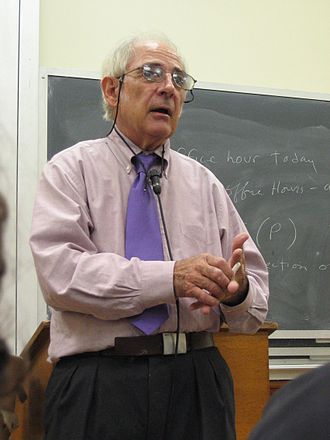
John Searle
philosopher, university teacher, artificial intelligence researcher, linguist
Read on Wikipedia1932 – 2025
All Quotes by John Searle
“My car and my adding machine understand nothing: they are not in that line of business.”
“The problem posed by indirect speech acts is the problem of how it is possible for the speaker to say one thing and mean that but also to mean something else.”
“The ascription of an unconscious intentional phenomenon to a system implies that the phenomenon is in principle accessible to consciousness.”
“Where conscious subjectivity is concerned, there is no distinction between the observation and the thing observed.”
“Materialism ends up denying the existence of any irreducible subjective qualitative states of sentience or awareness.”
“Dualism makes the problem insoluble; materialism denies the existence of any phenomenon to study, and hence of any problem.”
“Precisely by inculcating a critical attitude, the "canon" served to demythologize the conventional pieties of the American bourgeoisie and provided the student with a perspective from which to critically analyze American culture and institutions. Ironically, the same tradition is now regarded as oppressive. The texts once served an unmasking function; now we are told that it is the texts which must be unmasked.”
“In the performance of an illocutionary act in the literal utterance of a sentence, the speaker intends to produce a certain effect by means of getting the hearer to recognize his intention to produce that effect; and furthermore, if he is using the words literally, he intends this recognition to be achieved in virtue of the fact that the rules for using the expressions he utters associate the expression with the production of that effect.”
“Whatever is referred to must exist. Let us call this the axiom of existence.”
“The general nature of the speech act fallacy can be stated as follows, using “good” as our example. Calling something good is characteristically praising or commending or recommending it, etc. But it is a fallacy to infer from this that the meaning of “good” is explained by saying it is used to perform the act of commendation.”
“The assertion fallacy ... is the fallacy of confusing the conditions for the performance of the speech act of assertion with the analysis of the meaning of particular words occurring in certain assertions.”
“Well, what does “good” mean anyway...? As Wittgenstein suggested, “good,” like “game,” has a family of meanings. Prominent among them is this one: “meets the criteria or standards of assessment or evaluation.””
“Where questions of style and exposition are concerned I try to follow a simple maxim: if you can’t say it clearly you don’t understand it yourself.”
“It seems to me obvious that infants and many animals that do not in any ordinary sense have a language or perform speech acts nonetheless have Intentional states. Only someone in the grip of a philosophical theory would deny that small babies can literally be said to want milk and that dogs want to be let out or believe that their master is at the door.”
“An utterance can have Intentionality, just as a belief has Intentionality, but whereas the Intentionality of the belief is intrinsic the Intentionality of the utterance is derived.”
“I will argue that in the literal sense the programmed computer understands what the car and the adding machine understand, namely, exactly nothing.”
“The Intentionality of the mind not only creates the possibility of meaning, but limits its forms.”
“You need to know enough of the natural sciences so that you are not a stranger in the world.”
“You need to know at least one foreign language well enough so that you can read the best literature that that language has produced in the original, and so you carry on a reasonable conversation and have dreams in that language. There are several reasons why this is crucial, but the most important is perhaps this: you can never understand one language until you understand at least two.”
“You need to know enough philosophy so that the methods of logical analysis are available to you to be used as a tool. One of the most depressing things about educated people today is that so few of them, even among professional intellectuals, are able to follow the steps of a simple logical argument.”
“Finally, and perhaps most importantly, you need to acquire the skills of writing and speaking that make for candor, rigor, and clarity. You cannot think clearly if you cannot speak and write clearly.”
“Just acquiring this amount of "education" will not, by itself, make you an educated person, even less will it give you what Oakeshott calls "judgment." But if the manner of instruction is adequate, the student should be able to acquire this much knowledge in a way that combines intellectual openness, critical scrutiny, and logical clarity. If so, learning will not stop when the student leaves the university.”
“I want to block some common misunderstandings about "understanding": In many of these discussions one finds a lot of fancy footwork about the word "understanding."”
“I will argue that in the literal sense the programmed computer understands what the car and the adding machine understand, namely, exactly nothing.”
“In many cases it is a matter for decision and not a simple matter of fact whether x understands y; and so on.”
“My car and my adding machine understand nothing: they are not in that line of business.”
“Our tools are extensions of our purposes, and so we find it natural to make metaphorical attributions of intentionality to them; but I take it no philosophical ice is cut by such examples.”
“The sense in which an automatic door "understands instructions" from its photoelectric cell is not at all the sense in which I understand English.”
“There are clear cases in which "understanding" literally applies and clear cases in which it does not apply; and these two sorts of cases are all I need for this argument.”
“We often attribute "understanding" and other cognitive predicates by metaphor and analogy to cars, adding machines, and other artifacts, but nothing is proved by such attributions.”
“I have only one real message in this lecture, and that is: consciousness is a biological phenomenon, like photosynthesis, digestion, mitosis—you know all the biological phenomena—and once you accept that, most, if not all about the hard problems of consciousness simply evaporate.”
“Descartes may have made a lot of mistakes, but he was right about this: you cannot doubt the existence of your own consciousness. That's the first feature of consciousness, it's real and irreducible. You cannot get rid of it by showing that it's an illusion in a way that you can with other standard illusions.”
“There is one mistake we got to avoid, and that is the mistake of supposing that if you simulate it, you duplicate it. This is a deep mistake embedded in our popular culture - that simulation is equivalent to duplication, but of course it isn't. A perfect simulation of the brain - say, on a computer - would no longer thereby be conscious than a perfect simulation of a rainstorm on a weather-predicting computer will leave us all wet.”
“We often attribute 'understanding' and other cognitive predicates by metaphor and analogy to cars, adding machines, and other artifacts, but nothing is proved by such attributions.”